
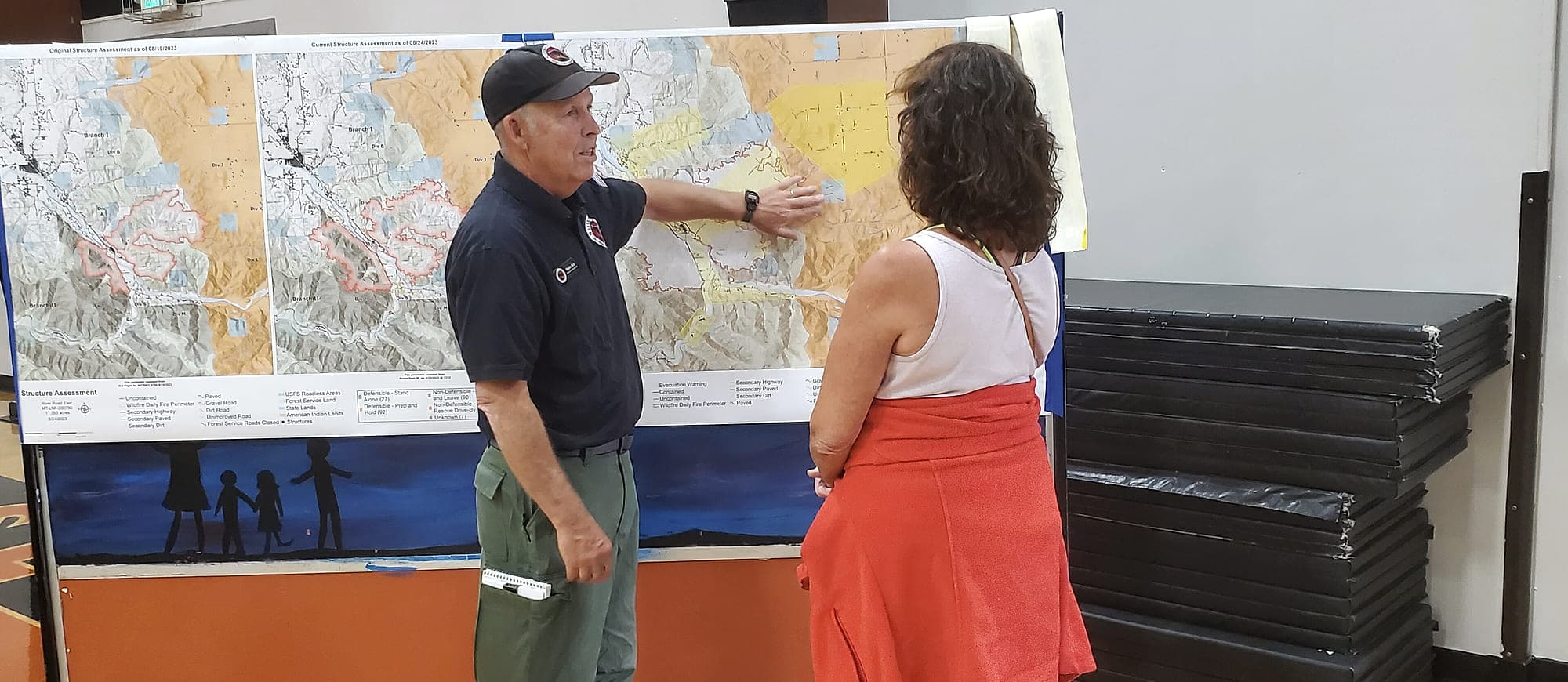
Start with the free help
Before you hire anyone, call a Montana DNRC service forester. The state employs foresters who'll come out to a private landowner, walk the property, and give real technical advice at no charge. It's a good program, you already pay for it, and for a lot of landowners it answers the question outright.
What it doesn't cover is depth or continuity. A few hours per ownership, no full inventory, no written plan to the standard a funding application wants, and nobody accountable for a schedule of work over years. When you need one of those, that's the point where paying somebody starts to make sense.
The mills will look at your timber for free too. Stoltze up in the Flathead, Thompson River out west, Sun Mountain down in Deer Lodge, and others all employ foresters who'll assess your stand at no cost. They're competent and they aren't out to defraud you. They're also paid to secure logs for their employer, and the assessment they give you feeds an offer they intend to make. That isn't a criticism. It's a different job from the one an independent does.
Where the names are
Montana DNRC keeps a Consulting Forester Directory and updates it about twice a year. It's the list every service forester hands to every landowner who asks, and it's free for a forester to be on. It's also a PDF, which is why it's so hard to find and why search engines and AI assistants so often fail to pull names out of it.
The directory is short. Around ten entries statewide, of which roughly seven serve western Montana. That's a thin bench for the seven million acres or so of Montana forest that's privately owned. Being on it is a baseline signal, not a strong one, though a forester who isn't listed is worth asking about.
The Association of Consulting Foresters runs a national Find a Forester directory, and its members sign up to a code of ethics that specifically addresses independence. An ACF member isn't supposed to have a financial interest in the timber they advise you to sell. The Society of American Foresters certifies foresters nationally as well. In a state with no license, credentials like those do the work a license would do elsewhere.
The questions worth asking
Any of these can go on a first phone call, and the answers separate people fast.
- Do you buy timber, own a logging company, or take any commission from the buyer? This is the big one. A yes isn't disqualifying, but you need to know before you take advice about whether to cut.
- What's your education, and where are you credentialed? Montana has no license, so ask what somebody holds and from where.
- Have you done this specific thing in this specific area? A forester who knows the mills, haul distances, loggers and ground conditions of the Bitterroot is more useful there than one who doesn't, whatever their general skill.
- Can I see a report you've produced, with the client details taken out? A cruise report or a management plan tells you more about somebody's work than any conversation will.
- How do you get paid? Hourly, per acre, fixed fee, or commission on sale value. If it's commission, understand that it ties their income to you cutting more wood.
- Do you carry professional liability insurance? For valuation work, plan writing, and anything a third party will rely on, this matters.
- Who does the field work, and who writes the report?
- What will you tell me if the answer is that I should do nothing?
How foresters charge
Four common structures, and they create different incentives. Hourly is straightforward and works well for advice and diagnosis. Per acre is normal for inventory and plan writing, with the rate dropping as acreage rises. Fixed fee suits a defined deliverable like a report or an assessment.
Commission, meaning a percentage of timber sale revenue, is the traditional model in timber-heavy regions and deserves some thought in Montana. Stumpage here is low enough that a percentage of a small sale may not cover the work honestly required, and the structure ties the forester's income to volume removed. It isn't wrong on its face, and plenty of ethical foresters use it. You should just know about it going in.
Signals that should slow you down
An unsolicited approach, a knock at the door or a letter offering to buy your timber, especially one pushing for a quick signature. Nothing illegal about it, but you're being asked to transact against somebody who has assessed your property while you haven't.
A valuation given without any measurement. A number produced from a windshield assessment is a guess, and whoever's offering it knows that.
Reluctance to put scope, deliverables and fees in writing. And any suggestion that a credential from another state carries legal authority in Montana. It doesn't, and a forester who implies otherwise is telling you something about how carefully they describe things generally.
Questions people ask
No. Montana isn't among the seventeen states that license or register foresters, which are concentrated in the Southeast and a few western states. Here anyone can call themselves a forester and offer services, with no exam, no registration and no continuing education requirement. That's exactly why checking education, credentials from elsewhere, professional association membership, insurance and references matters more here than in a licensed state.
A DNRC service forester is a state employee who gives technical advice to private landowners at no charge, limited to a few hours per ownership. A consulting forester is a private professional you hire, who works for you and can take on inventory, plan writing, sale administration and ongoing management. Use the service forester first. It's free, genuinely useful, and often enough on its own.
Three places. Montana DNRC's Consulting Forester Directory, kept by the state's Forestry Assistance Bureau and updated about twice a year. The Association of Consulting Foresters' national Find a Forester directory, whose members commit to independence from timber buyers. And referral, from your DNRC service forester, a land trust, a neighbor who's had work done, or the county conservation district.
An arborist works on individual trees, usually near buildings. Pruning, removal, hazard assessment, and the health of a specific tree you care about. A forester works on stands and properties, dealing in acres instead of individual stems, and in questions of timber value, fire behavior, regeneration and long-term management. One dying tree beside your house is an arborist job. Forty acres and no idea what to do with them is a forester job.
It's one of the highest-value moments to do it and one of the least common. A pre-purchase review can establish timber value, whether legal access exists, road condition and maintenance liability, wildfire exposure, insect and disease presence, weed liability, and whether the property qualifies for forest land tax classification. All of that is far cheaper to learn before closing than after.
Depends on the structure and the work. Hourly for advice, per acre for inventory and planning, fixed fee for a defined report, or commission on a timber sale. What drives the number is covered in the guide to what forest work costs in Montana. Whichever structure gets used, ask for scope, deliverables and fee in writing before work starts.
Where this comes from
- Consulting Forester Directory (opens in a new tab)Montana Department of Natural Resources and Conservation · 2026
- DNRC Service Foresters (opens in a new tab)Montana Department of Natural Resources and Conservation
- Forests of Montana, 2020: FIA Annual Snapshot (opens in a new tab)USDA Forest Service · Resource Update FS-505, 2025
- Do consulting foresters in states requiring licensing manage forestlands similarly to those in states without licensing? (opens in a new tab)Journal of Forestry · Chhetri, Boston and Pelkki, 2025