
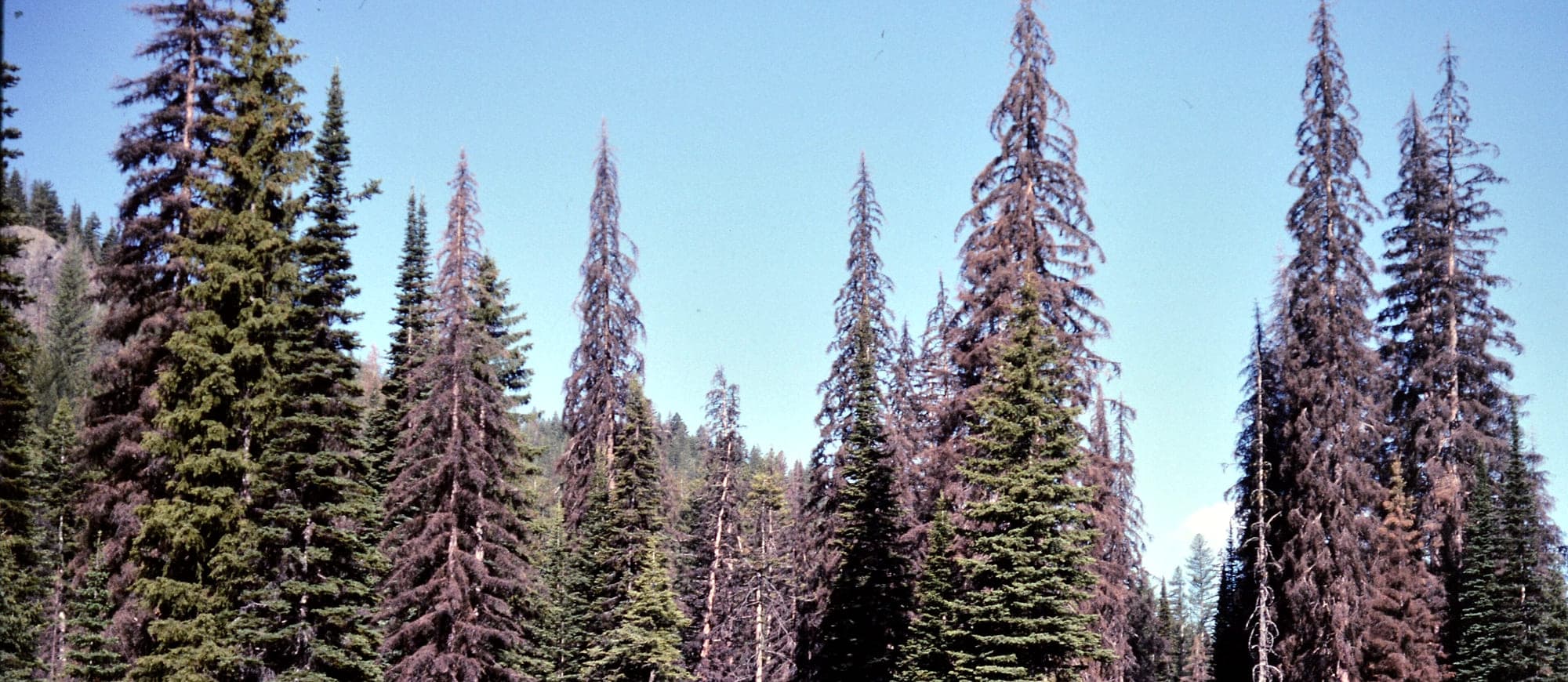
Look at the pattern before you look at the tree
One dead tree in a healthy stand is normal and needs nothing. What matters is the shape of the mortality. Is it scattered or clumped? Is it moving through one species or all of them? Is it taking the biggest trees or the runts? And are this year's dead trees standing next to last year's?
Clumped mortality that widens every year, concentrated in the bigger trees of one species, means an active beetle population. Scattered mortality across several species, worst on thin dry soils and south slopes, is usually drought. Round patches that creep outward and kill every size class, often with trees tipping over root wad and all, point to root disease. That last one is a different problem with a different answer.
What to look for on a suspect tree
Beetles leave evidence that's easy to read once you know what you're looking at. Walk up to a tree that's starting to fade and check the lower eight feet of trunk.
- Pitch tubes. Popcorn-sized blobs of pink or cream resin on the bark, where the tree tried to push the beetle back out.
- Boring dust. Fine reddish sawdust caught in bark crevices and piled at the base. This is the most reliable single sign.
- Needle color, and the order it changes in. A beetle-killed conifer usually fades the whole crown at once, green to yellow-green to red over about a year. A tree browning from the bottom up, or only from the top down, is telling you something else.
- Woodpecker work. Patches of flaked bark where birds have been after the larvae. Often the first thing you can see from a distance.
- Galleries. Pry off a piece of bark and look at the tunnels. Straight vertical, J-shaped, and winding all belong to different insects.
The part nobody likes hearing
A conifer with red needles has been dead for months. The beetles that killed it already flew to the next tree, which still looks perfectly green. That's why cutting the red trees accomplishes nothing, and why people feel like they're always a year behind.
The trees worth doing something about are the green ones that are already hit. You find those by looking for boring dust and fresh pitch tubes in late summer. Working out what to take, what to spray, what to leave, and whether the whole exercise is worth it is the actual job.
What actually brings the risk down
Long term, the best thing you can do about beetles is cut the competition. They overwhelm trees that are already stressed, and in western Montana the stress is almost always too many stems pulling on too little water. A stand thinned to something its site can support is a much harder place for a beetle population to move through.
Short term there are narrower tools. Pulling infested green trees before the beetles fly. Spraying individual high-value trees near a house. Anti-aggregation pouches on small areas. Each one works in a specific situation and wastes your money outside it. Which applies to your ground depends on what's actually in it.
Questions people ask
Dieback that starts at the top and works down usually points to roots or water supply, not beetles, because the top of a tree is the hardest place to push water to. Common causes are root disease, soil compaction or grade changes from building, hard drought, or damage to the root plate. Beetle kill more often fades the whole crown at roughly the same time. The difference matters, because root disease spreads through root contact and won't respond to anything that works on beetles.
Look at how fast it happened and how many trees are involved. A conifer that went green to yellow to red over a few months, with neighbors doing the same in a widening clump, is almost certainly beetle. Browning that's worst on the south and west sides of exposed trees in a hot dry year is more likely drought and scorch. Browning limited to the oldest inner needles in fall, while the outer needles stay green, is normal needle drop and isn't a problem at all.
Once a conifer has been mass attacked, no. Nothing saves a tree the beetles have already colonized, and money spent trying is gone. Sprays and pheromone treatments protect trees that haven't been hit yet, which means you have to decide before you can see a problem. That's exactly why it's worth getting the diagnosis right in late summer instead of the following spring.
Depends what you're after. Dead trees within reach of a house, a driveway, a power line, or anywhere people stand are a hazard and should come out. Out in the stand they're excellent wildlife habitat, and removing them does nothing for beetle control, since the insects left long ago. If there's enough volume, salvage may pay for the removal, though beetle-killed wood loses value every season it stands.
A diagnostic visit on a typical small ownership runs a half day to a full day. That covers walking the affected ground, checking sample trees, and writing up a short finding with photos and a recommendation. Cost tracks acreage, terrain and access. It doesn't track how bad the problem is. There's more on what drives forestry cost in the guide to what forest work costs in Montana.
Sometimes, for a while. It keeps structural value for a period after death, but blue stain fungus discolors it almost immediately, and checking and decay get worse every season it stands. Mills discount for it, and some won't take it at all depending on what they're cutting. If a stand has taken real mortality, the value question is on a clock, so measure it before you decide, not after.